The Gain
With Teeth
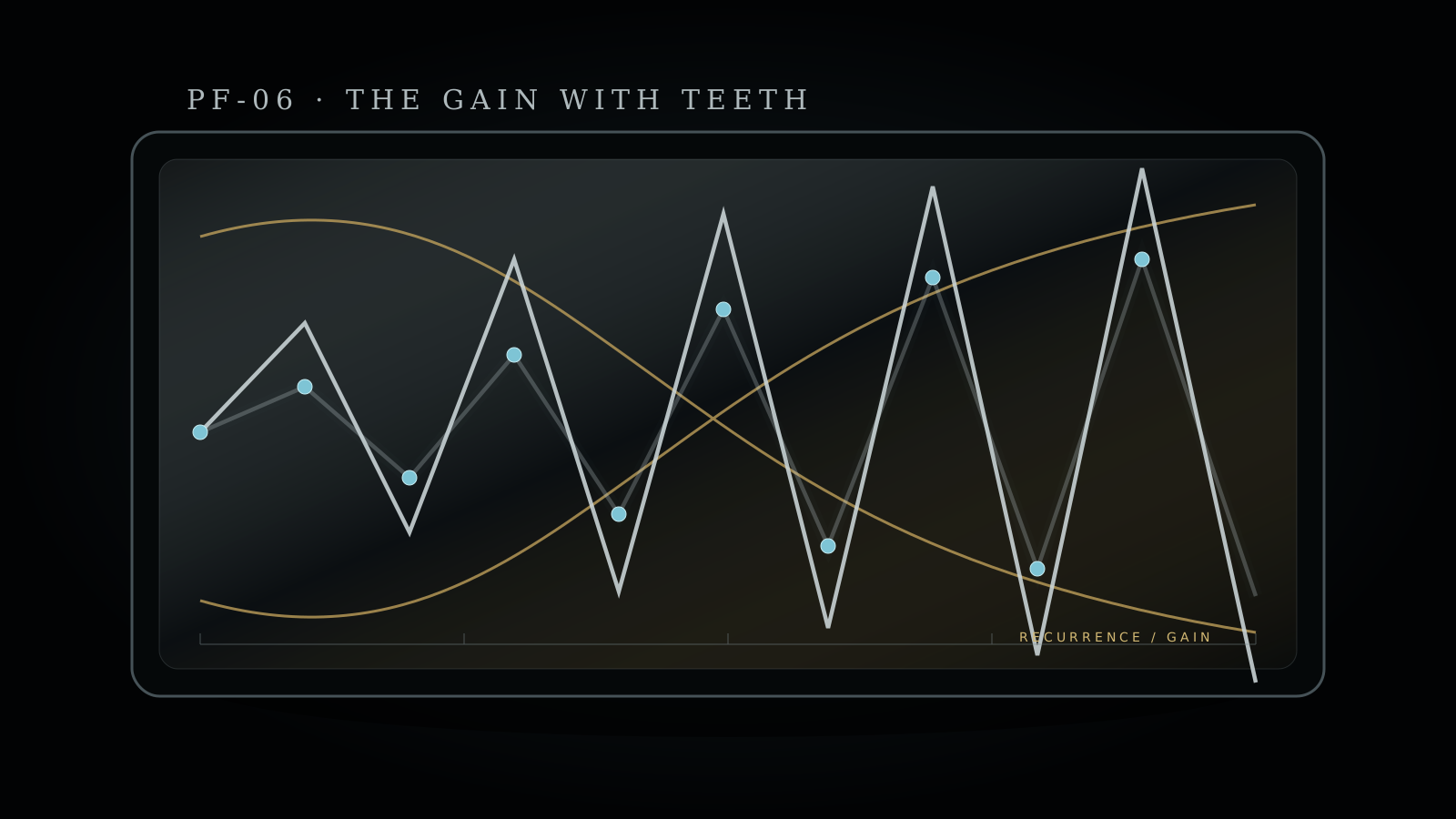
A system grows by 20% every tick unless feedback pushes back. Turn the gain and give it a pulse: sometimes the trace glides home, sometimes it crosses zero like a pendulum, and sometimes the controller bares its teeth. The instrument reveals why after you watch it happen.
The gain's. More feedback is not automatically better. The same control law can produce smooth decay, sign-changing decay, a neutral oscillation, or divergence.
Turn the gain. Watch the system choose its personality.
No prediction is required. Choose a gain, run the recurrence, and watch magnitude and sign. Once the shape appears, open the multiplier to see the compact rule hiding underneath it.
Four shapes you should recognize
These are generic examples, not answers for the selected gain. Learn the visual grammar first.
Open the rule behind every trajectory.
Open the mathematics behind the teeth
Every tick multiplies the current state by the same closed-loop factor:
Repeated multiplication approaches zero exactly when |m| < 1. Therefore the stabilizing interval in this toy model is:
Negative multipliers inside that interval produce alternating convergence. At k = 2.2, m = −1, so the state flips sign forever without shrinking. That is the tooth: more feedback is not monotonically better.
Your runs suggest the same multiplier repeats. Which condition makes repeated powers approach zero?
Observe the marked gains first.
Once you have the right multiplier condition, enter the exact stabilizing interval for k.
Brute-force examples are evidence. The interval still needs a derivation.
Negative multipliers with magnitude below one produce alternating convergence, not instability. At k = 2.2 the multiplier is −1, so the system alternates forever instead of converging. More gain is therefore not monotonically better.