THOUGHT INSTRUMENTS / CONJUNCTION GAME

Mysterium Coniunctionis

A Glass Bead Game for Strange Correspondences.

A contemplative playfield of twenty-seven beads where worlds, minds, and meanings resonate. Explore correspondences. Compose constellations. Discover new conjunctions.

FORMAL PLAY5 GENERATIVE · MACHINE-ENFORCED FAMILIES
STATESAVE · RESUME · SHARE · REVALIDATE
SCOPEORIGINAL GLASS-BEAD INSTRUMENT
II

Conjunction Field

AWAITING TWO BEADS
Bring unlike things into relation.

The field will tell you whether the resemblance is lineage, analogy, convergence, coincidence—or a seductive false friend.

STRUCTURAL ANALOGY FALSE FRIEND / CAUTION DOCUMENTED LINEAGE OPEN COINCIDENCE INDEPENDENT CONVERGENCE
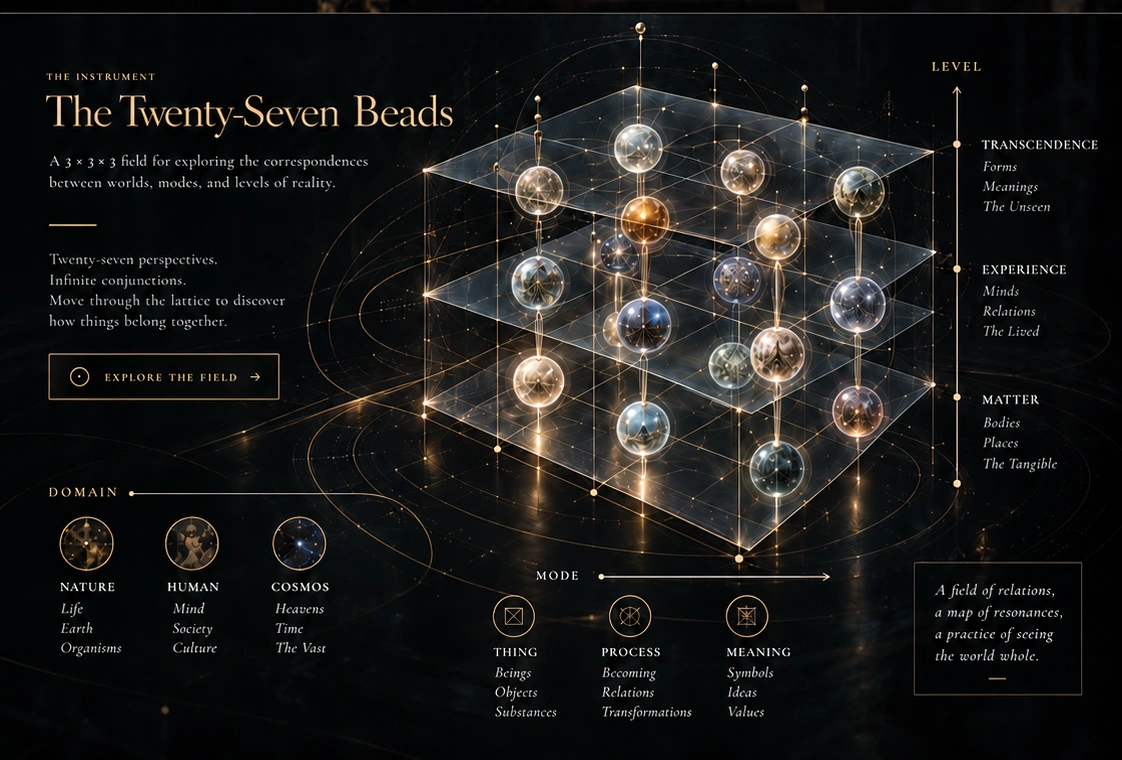
The Twenty-Seven Beads: an illustrated 3 × 3 × 3 field mapping Domain, Mode, and Level from Matter through Experience to Transcendence.
Twenty-seven perspectives arranged as a three-by-three-by-three field. Domains are Nature, Human, and Cosmos; modes are Thing, Process, and Meaning; levels rise from Matter through Experience to Transcendence.
01Resemblance is not causation.

A shared pattern can be useful without being a historical or scientific connection.

02Similarity must survive a boundary.

Every conjunction names where the analogy stops working.

03Coincidence may remain coincidence.

The game is permitted to leave an alignment unresolved rather than manufacture a secret.

INTELLECTUAL LINEAGE

Three acknowledgments. No borrowed authority.

HESSE

Hermann Hesse’s Das Glasperlenspiel—The Glass Bead Game—is an explicit intellectual ancestor for the room’s cross-disciplinary impulse. Mysterium does not claim to reconstruct Hesse’s fictional Game or its rules.

SOURCE / SUHRKAMP ↗

HOFSTADTER

The Bach × Gödel × Escher constellation has a major modern precedent in Douglas Hofstadter’s Gödel, Escher, Bach. Mysterium acknowledges that precedent while using its own relationship classes, authored cards, and explicit boundaries.

SOURCE / BASIC BOOKS ↗

TITLE / CONIUNCTIO / JUNG

Coniunctio belongs to historical alchemical language of conjunction, and Mysterium Coniunctionis is also the exact title of C. G. Jung’s major work on alchemy. Here the title names the disciplined act of bringing unlike objects into comparison. Jungian psychology, archetype, or synchronicity is not used as evidentiary authority for any conjunction.

SOURCE / PRINCETON–JSTOR ↗

PLAYABLE PRECEDENTS

Earlier real-world descendants of Hesse’s idea matter here as design history. Charles Cameron’s HipBone Games used repeatable idea-linking boards in competitive, collaborative, and solo play; Dunbar Aitkens’s Glass Plate Game mapped group conversation through thematic cards and explicit challenges; Ron Hale-Evans’s Kennexions developed strict analogy-based compositions and competitions in the early 2000s. Mysterium does not copy their boards or rule text. MC-R2 takes the replayability lesson seriously: broad combinatorial choice, defensible links, variable constraints, and room for mastery.

HIPBONE RULES / ARCHIVE ↗GLASS PLATE GAME / 2006 ACCOUNT ↗KENNEXIONS / GBG WIKI ↗

Provenance is not proof. These sources explain ancestry and title lineage. They do not validate the correspondences generated or authored inside this instrument.

CANONICAL RULEBOOK · MC-R2.0

Mysterium Rules / Codex

This is an original Glass-Bead instrument, not a reconstruction of a missing historical rulebook. MC-R2 adds a generative scenario engine, three difficulty levels, Daily Conjunctions, and Master Games. In formal PLAY, the rules below are the authority: the interface uses the same legality engine when a move is made live, resumed from local storage, or restored from a shared link.

1 · TWO WAYS TO ENTER

EXPLORE is unscored inquiry: select two or three beads, inspect the relationship class, compare, reveal resonances, and save a conjunction. PLAY is formal seeded play with explicit win/failure conditions.

2 · THE GRAMMAR

A move contains a bead, a claimed relationship class, a shared descriptor, and—when the puzzle requires it—an explicit boundary. Relationship basis is either authored or computed; basis is provenance, not a strength score.

3 · UNIVERSAL FORMAL TURN

  1. Choose a legal new bead.
  2. Claim the relationship class.
  3. Name one descriptor actually supported by that edge.
  4. Mark a boundary when required.
  5. Commit. An invalid attempt never changes the position; it is recorded in Move History.

4 · LEGALITY

A committed edge must exist in the instrument, the claimed class must match that edge, the descriptor must belong to that edge, no formal path may repeat a bead, and all challenge-specific constraints must remain satisfiable. Shared and saved states are revalidated before they are accepted.

01

BRIDGE

Reach the named target within the displayed move limit—sometimes an exact move count—while satisfying every domain, basis, lineage, coincidence, Mercurial-count, and exclusion condition. A FALSE FRIEND / CAUTION never advances a Bridge.

02

BREAK THE ANALOGY

Inspect an explicit false claim generated from the live relationship graph or drawn from a curated teaching case. Identify the exact category of overreach. Nothing is added to the board.

03

THE THIRD BEAD

The starting pair is generated from the relationship graph. Choose what the third bead must do—reinforce, complicate, break, or change the question—then find one of multiple machine-accepted solutions and defend its actual relationship class.

04

COUNTERWEIGHT

A strong starting pair is generated from the graph. Add one of several valid counterweights that preserves the useful relation while forcing it to stop at a real boundary. The move must use its actual relationship class.

05

CONSTELLATION

Build the exact seeded bead count across the required domains; include authored and computed relations; preserve a boundary; and return through the starting domain. Harder seeds may ban a domain, require a FALSE FRIEND, demand a relationship class, or require an exact number of Mercurial-world beads.

5 · AUTHORITY & EVIDENCE

DOCUMENTED LINEAGE, STRUCTURAL ANALOGY, INDEPENDENT CONVERGENCE, OPEN COINCIDENCE, and FALSE FRIEND / CAUTION are different claim classes, not ranks. An authored relation is not automatically stronger than a computed one. Epistemic text explains the claim and its failure boundary; it does not convert resemblance into scientific proof.

6 · STATE & ADJUDICATION

Undo removes the last committed formal move where the challenge permits it. Save / Resume stores this browser’s position. Share encodes the seed and state in the URL. On load, the instrument regenerates the seed and re-adjudicates the state; incompatible or tampered state is rejected rather than promoted to a win.

7 · DIFFICULTY & SERIES

APPRENTICE favors clearer relations and wider routes. ADEPT mixes authored and computed structure. MAGISTER increases exclusions, exact counts, false friends, and adversarial boundary tests. DAILY CONJUNCTION is deterministic for the calendar day; MASTER GAME launches a fresh Magister-level Constellation.

8 · RULESET VERSION / PRECEDENT

Formal states created by this build carry MC-R2.0. Older states are not silently reinterpreted. Mysterium acknowledges Hesse and earlier playable descendants such as HipBone Games, the Glass Plate Game, and Kennexions as design history; its rules, boards, relationship graph, and adjudication remain its own.

9 · THE TWENTY-SEVEN BEADS

Mysterium uses 27 beads as a deliberate 3 × 3 × 3 field. Read the chamber as three conceptual axes: X · Domain, Y · Mode, and Z · Level, moving from Matter through Experience toward Transcendence. The point is not numerological proof but a memorable geometry for disciplined comparison.

10 · THE HERMETIC NAVIGATOR

The chamber’s symbolic keeper is the Hermetic Navigator: part scholar, part astronomer, part musician. The Navigator’s emblem is the Celestial Bow, a stringed instrument and line of force at once. The player enters by inheriting that office rather than by serving a fantasy hero.

Adjudication principle: in formal PLAY, machine-enforced legality governs the move. Explanatory prose may clarify a judgment but cannot override a failed constraint.

LOCAL CABINET

Saved states

Formal games and exploratory conjunctions remain in this browser. Formal positions are revalidated against MC-R2.0 before play resumes.