Learn the machine.
Then let it become impossible.
A legible modular-synthesis teaching instrument that begins with one oscillator and progressively reveals envelopes, filtering, control voltage, sequencing, subharmonics, generative behavior, and the architecture behind the Mother-32, DFAM, Subharmonicon, and Labyrinth. The scientific and fictional layers remain deliberately distinct.
Frequency has three jobs here.
The same word appears on several parts of a synthesizer, but it describes different jobs. These three cards are a teaching doorway, not a claim that frequency is the whole machine.
The three frequency cards solve one vocabulary problem. The full instrument asks seven broader questions.
The panel stays readable while the system gets deeper.
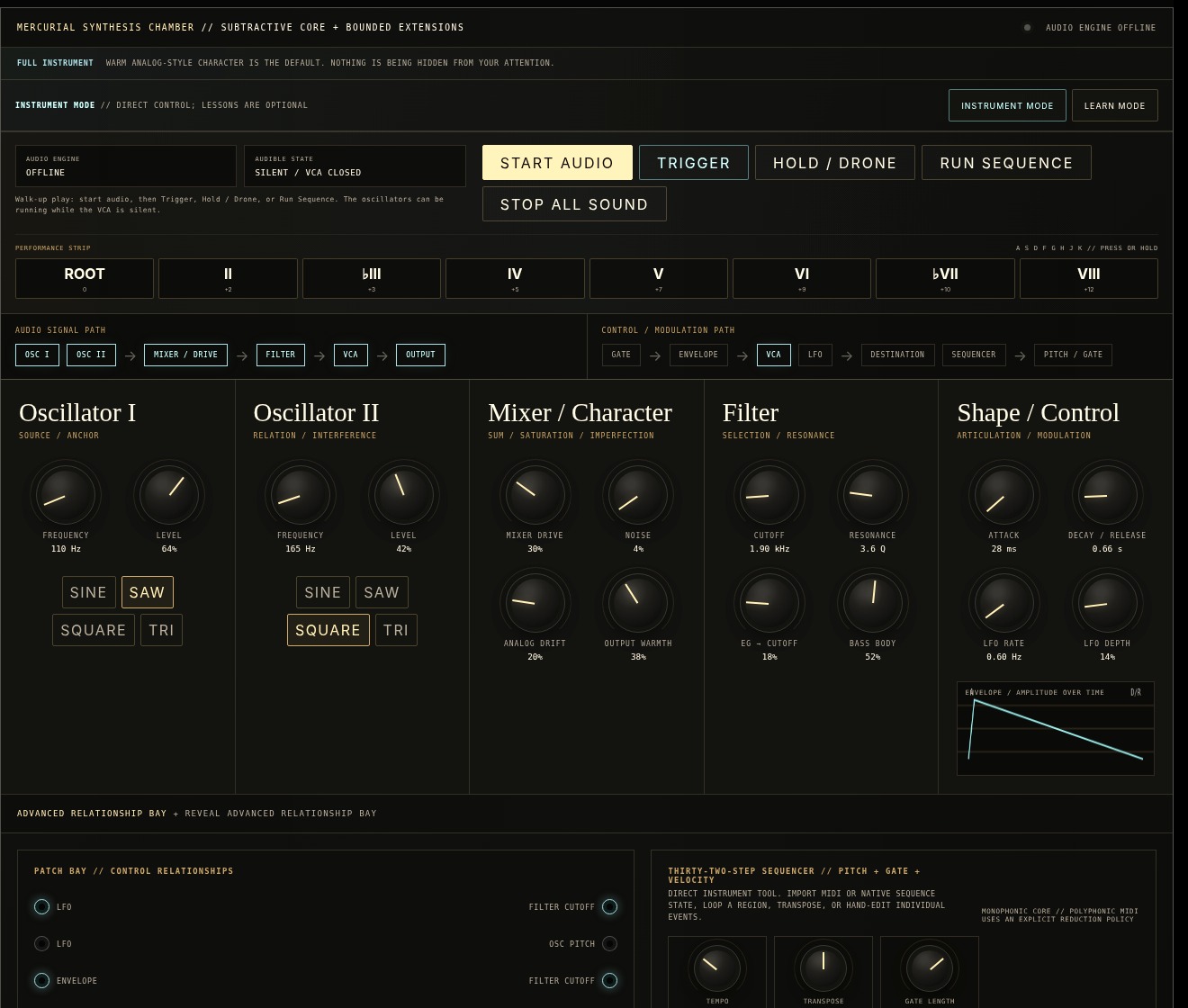
The core is a two-oscillator signal path. Teaching overlays, a visible envelope, a 32-step pitch/gate/velocity sequencer with MIDI import, warmer nonlinear behavior, and advanced bays appear only as you need them.
Walk-up play: start audio, then Trigger, Hold / Drone, or Run Sequence. The oscillators can be running while the VCA is silent.
Oscillator I
Oscillator II
Mixer / Character
Filter
Shape / Control
Advanced relationship bay
Derived subharmonics
Two parent oscillators can generate lower related tones by integer division. This is a teaching model of the relationship, not a reproduction of a branded circuit.
Generative / nonlinear tools
These browser tools teach the concepts behind ring modulation, wavefolding, noise, and bounded mutation. They are deliberately not a panel clone or circuit-identical model.
Patch bay // control relationships
Thirty-two-step sequencer // pitch + gate + velocity
Direct instrument tool. Import MIDI or native Sequence State, loop a region, transpose, or hand-edit individual events.
Let the phrase wander without losing home.
Generate a new working variation from the captured source. The source remains recoverable; Mercurial Sequence 01 remains separately protected.
hg.atelier.sequence.draft-0.3 working sequence data. Mercurial Exchange MIDI Format 0/1 PPQ files are supported; polyphonic onsets are reduced by the selected policy and imports remain a working sequence only. Scale-assist entries are interval sketches only — not raga, makam, temperament, or performance-practice models.Discover by progressive revelation.
All 13 discoveries use the same large instrument. Bright means touch this now; normal visibility means useful context; gray means let it recede for this moment. Nothing here is a quiz: hear the consequence first, then open the explanation.
Where sound begins.
Why it sounds warm — one cause at a time.
The instrument is warm by default. This optional ear-training sequence temporarily strips the character back to a clean reference and then rebuilds it so you can hear what each stage contributes.
Let the source arrive. Then let the Chamber realize it.
Compatible harmonic-state files are validated before they can affect the instrument. The Chamber shows what maps, what is lost, and what the synthesis engine adds; working state changes only after explicit approval.
Preview first.
Cross second.
The source is not modified here. A Harmonic State may carry mathematical or musical structure, provenance, losses, assumptions, and an explicit mapping. The Chamber owns only the audible/playable realization after you choose Apply Import. Structural correspondence does not confer musical authority or establish physical causation.
Advanced local Chamber State / JSON serialization
Preview a machine state, load a local Chamber State, or import a separate Harmonic Bridge State through the preview boundary.
Acoustic and biological effects need more than a number in hertz.
This is a design boundary for future work, not a treatment tool. It prevents popular “healing frequency” claims, calibrated therapeutic acoustics, psychoacoustics, and Mercurial fiction from being collapsed into one category.